Indian And Cowboy Creatives Statement On The Rise Of Indian REsidential School Denialism In Canada
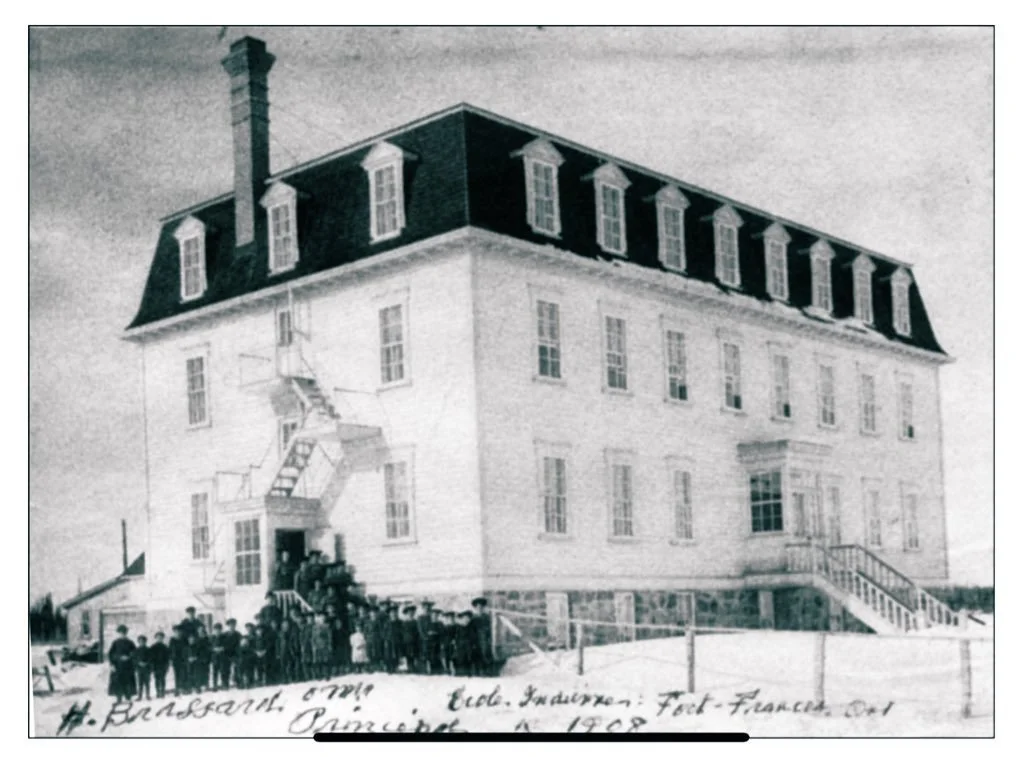
St. Margarite’s Indian Residential School // Couchiching First Nation 1908
Indian & Cowboy Creative is issuing this statement in response to a recent Globe and Mail editorial board opinion piece titled There Is No Reconciliation Without Truth and the broader public reaction that followed its publication.
The Globe and Mail occupies a unique position in Canadian public life. As Canada's national newspaper of record, its reporting, editorials, and editorial judgments carry significant influence in shaping public discourse.
For that reason, we believe it is important to respond.
To be clear, we do not dispute the editorial's central assertion that truth matters.
Truth does matter.
Historical accuracy matters.
Journalistic rigour matters.
The public deserves accurate reporting, thoughtful analysis, and responsible corrections when errors occur.
Over the past five years, Canadian media organizations, including the Globe and Mail itself, have publicly wrestled with questions surrounding the reporting of potential unmarked burial sites at former Indian Residential Schools. Corrections, clarifications, and explanations have been published. Journalists, editors, researchers, survivors, communities, and readers have engaged in important conversations about language, evidence, and reporting standards.
Those conversations have already occurred.
Which is why we find ourselves asking a different question:
Why revisit this debate now?
And why on the eve of National Indigenous History Month?
What public purpose was served by elevating this discussion at a moment when Canadians were preparing to reflect on Indigenous histories, cultures, experiences, and contributions?
These questions are particularly important because of what happened next.
Within hours of publication, the editorial was being celebrated and circulated by individuals and organizations that routinely attack Orange Shirt Day, dismiss survivor testimony, question the findings of the Truth and Reconciliation Commission, and characterize the Indian Residential School system as something other than the destructive policy of forced assimilation that it was.
The question is not whether the Globe intended this outcome.
The question is whether anyone could reasonably be surprised by it.
The debate is no longer simply about terminology.
It is no longer about whether a journalist used the correct phrase in a headline in 2021.
The goalposts have moved.
What began as discussions about language, reporting standards, and archaeological methodology has increasingly become something far more troubling: an organized effort to undermine survivor testimony, challenge the historical record, and weaken public support for reconciliation itself.
This is the environment in which the editorial was published.
And this is why we are concerned.
The historical record is clear.
The Indian Residential School system was a government-sanctioned policy of forced assimilation. Indigenous children were removed from their families, communities, languages, cultures, and territories. Thousands died while attending these institutions. Countless others experienced physical, emotional, spiritual, and sexual abuse. The impacts continue to shape Indigenous families and communities today.
These realities are not matters of opinion.
They are supported by survivor testimony, church records, government records, academic research, legal findings, and the work of the Truth and Reconciliation Commission of Canada.
At Indian & Cowboy Creative, we believe public conversations about evidence, language, and historical interpretation are both necessary and healthy.
However, we also believe Canadians must remain attentive to the broader context in which those conversations occur.
When questions that have already been publicly debated, corrected, and clarified are reintroduced into the national conversation, we must ask what effect that intervention will have and who ultimately benefits from it.
That responsibility is particularly important for institutions whose influence extends far beyond a single news cycle.
Indian & Cowboy Creative is committed to producing journalism, podcasts, documentaries, educational resources, and public conversations focused on Indigenous experiences, histories, rights, and contemporary realities.
Our work is grounded in a simple belief:
Truth matters.
But truth alone is not enough.
Reconciliation was never meant to end with awareness.
It was meant to begin there.
At a moment when denialism and historical revisionism are becoming increasingly visible in Canadian public discourse, we reaffirm our commitment to evidence-based, Indigenous-led storytelling that preserves public memory, supports informed dialogue, and contributes to a more honest understanding of this country's past and present.
The truth does not become less true because it is challenged.
And our responsibility to tell it does not diminish because some would rather look away.
— Indian & Cowboy Creative